Everything below describes what the product does and how it is checked. It does not quote a measured accuracy figure, because the differentiator is not a single headline number — it is that every output carries its own quantified, validated uncertainty.
A · ACCURACY & VALIDATION
How good is it, and how would I know?
We do not lead with a single accuracy percentage. Instead, every district value is delivered as a calibrated prediction interval built with conformal methods, so the band has a guaranteed coverage rate: when we say a value sits inside its interval with a stated probability, that frequency holds out of sample. You underwrite against the margin, not against a point estimate you have to trust blindly.
- Independent reference. Downscaled water-storage trends are benchmarked against national geological-survey monitoring-well networks, district by district.
- Honest failure mode. A district that fails the agreement check is flagged "insufficient agreement" and is not scored — rather than shipped with a flattering number.
- Continuous, not one-off. The benchmark is re-run with each new data release and ships as a validation pack, kept current for the life of the contract.
B · RESOLUTION & UPDATE FREQUENCY
How fine, how often?
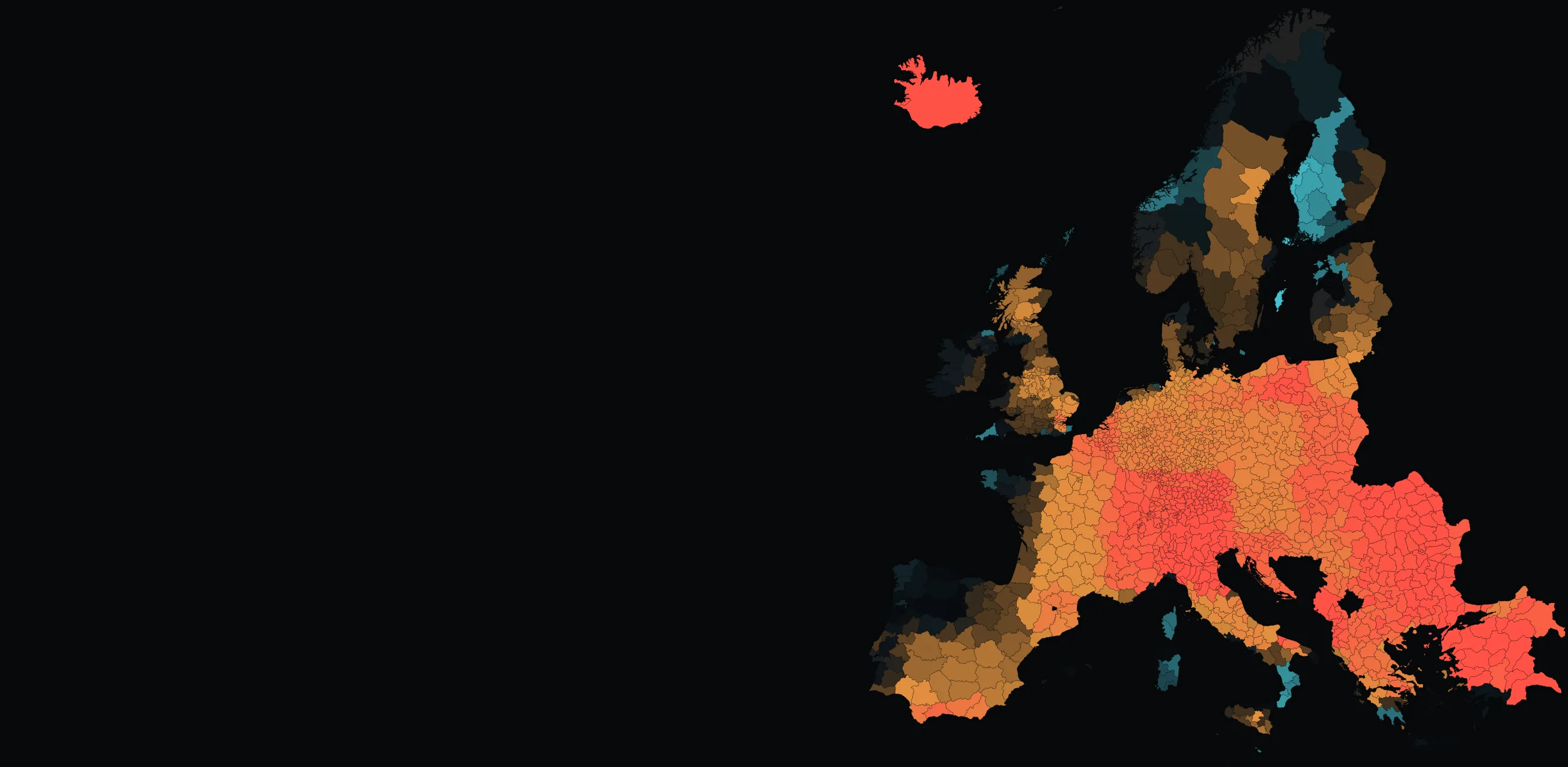
Spatial: delivered at administrative-district (LAU) resolution, downscaled from a native gravimetric footprint that spans hundreds of kilometres.
Temporal: refreshed on the cadence of the underlying gravimetry releases — a new measurement each cycle, with no fabricated values invented between releases.
C · INTEGRATION
How does it reach my systems?
- API — district indicator plus interval, queried by code or region ID.
- GeoTIFF — georeferenced raster for direct load into GIS.
- PDF report — portfolio or district brief for committee and disclosure files.
- SaaS dashboard — hosted view for analysts who do not run a GIS.
Vector and raster exports import into standard GIS and risk platforms; tabular feeds map onto existing scoring pipelines.
D · TECHNOLOGICAL LIMITATIONS — HANDLED HONESTLY
Where the method is weak, and what we do about it
Gravimetry's native footprint is coarse — a single raw cell can span an area the size of half a country. We never pretend otherwise: the downscaling step is physically constrained and reports its own uncertainty, so a district interpolated from a sparse signal carries a visibly wider band than one anchored by dense ground reference. Districts where the signal cannot be resolved with confidence are flagged, not silently filled.
Gravimetry measures total water mass and cannot, on its own, separate deep aquifer change from soil and surface water. We mitigate by combining it with independent surface-balance signals and calibrating against monitoring wells, so the delivered indicator isolates the structural groundwater component rather than a raw mass total.
E · COMPLIANCE & STANDARDS
Where it fits disclosure
Outputs are designed to support CSRD and EU Taxonomy water-risk disclosure with an auditable chain from signal to figure. Processing and delivery run under EU data residency.
We claim relevance, not certification: we do not hold a regulatory seal, and we say so plainly. The validation pack is built so your auditors can replay any figure we issue.
F · DELIVERY FORMATS
What you actually receive
- API endpoint with value + interval + validation flag
- GeoTIFF raster layers
- Vector district tables (CSV / GeoPackage)
- PDF portfolio and per-district briefs
- Hosted dashboard access
G · HORIZON
What time frame the indicator speaks to
This is a structural trend product, not a short-horizon forecast. It quantifies the multi-year slope of water storage — how fast reserves are gaining or draining once the season is removed — and the statistical significance of that slope. That is precisely the signal a multi-year loan, a renewing treaty or a long-lived abstraction licence is exposed to.