KEY JUDGMENTS
- A full reservoir is not a safe one. Two losses run beneath an unchanged level: water turning unsafe as a bloom builds, and live storage silting up from the floor. A staff gauge measures height, not health, and cannot see either.
- The water reports its own state from above. Extent, colour and clarity read directly off the surface on each clear pass; lost storage is inferred, not seen, by pairing the surface with the basin's known sediment load.
- The reading lands on a named lake, with the gaps marked. Cloud hides the surface and a coarse pass can smear several small reservoirs into one patch; a body under a week of cloud is reported as unseen, not guessed, and every value carries a stated margin of error.
- Outlook — the value is in moving the moment of knowing earlier. Catch a bloom in the colour days before it reaches the intake, and an operator can switch or treat a source rather than issue an advisory after the fact. The open question is whether each orbital signal holds up against the ground references it is checked against.
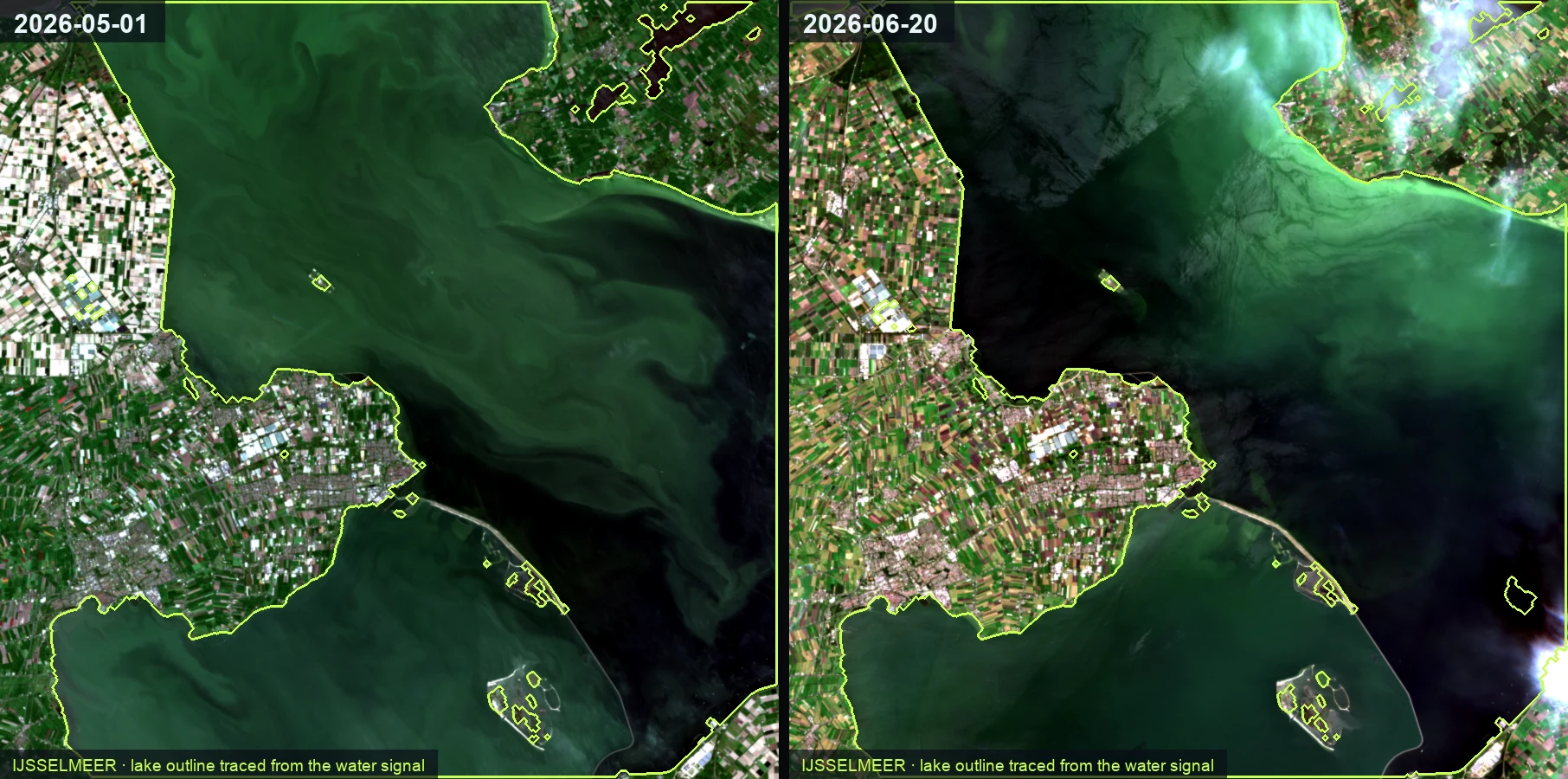
A full reservoir is not a safe one
A reservoir is the most reassuring thing in a water system — large, visible, and when it's full it looks like security itself. That look can be misleading. A reservoir can be brim-full of water that's turning unsafe to drink, and at the same time slowly filling, from the bottom up, with silt that no level reading will ever show.
Two losses run quietly beneath the surface. The first is quality. Warm, still, nutrient-rich water breeds algae, and once a bloom takes hold the change comes fast: the water greens, some blooms turn toxic, and a supply that was fine on Monday can foul an intake by the weekend. The second loss is room. Every river carries sediment, and where the water slows behind a dam, that sediment settles and stays there. Year by year it eats into the live storage the reservoir was built to hold. So the dam still stands, the lake still glints, but the cushion against the next drought is smaller than the design papers claim.
Both losses are easy to miss, mostly because neither shows up from the dam wall. A staff gauge measures height, not health. It can't see the floor. By the time a bloom reaches the intake, or a drought finds the missing storage, the trouble has usually been building for years already.

Why lost room is worse than a dry year
A drought, for all its damage, is basically a loan. The rain that ends it repays the storage it drew down, and the reservoir returns more or less to the state its operators planned for. Silt doesn't work that way. The room the sediment takes is gone for good, short of dredging, and the next drought arrives to find a smaller cushion than the last one did.
That's the double loss in its plainest form. Water can be replaced. Room can't — not cheaply, anyway. And the two losses feed each other: a reservoir that's lost room to silt holds a shallower, warmer, stiller body of water, and warm, still water is exactly what a bloom needs. So the storage problem quietly grows the quality problem underneath it.
It also hides inside the numbers that look most reliable. A gauge reading the reservoir at full is reading the level, not the volume — and the volume is set against a floor that's been rising since the dam was built. The percentage on the operator's screen gets computed against room that no longer exists. A drought announces itself. This loss just gets subtracted silently from every figure downstream of it.
What the water gives away from above
Water is unusually honest with a satellite. Unlike a forest or a city, its appearance is a fairly direct report on its own state, and three things can be read from orbit without anyone setting foot on the shore. The first is extent — where the water meets the land. Trace that shoreline against the full-pool mark, and the difference is the drawdown: the storage story told in plain outline.
The second is colour. Clear water and green water reflect light differently, and the orbital signal tells them apart. A rising green means an algal bloom is building. A sudden brown means a storm has just delivered a load of sediment and the water has lost its clarity. The third is the silt that's already settled. No camera sees through to a reservoir's floor. But the loss of room can be inferred over time, by pairing what the orbit measures on the surface with what's known about how much sediment the basin upstream delivers. None of this comes from a single snapshot — it's the same water read again on each pass, so a change registers as a change instead of a one-off reading nobody can place.
The colour reading itself has a published pedigree. The Normalized Difference Chlorophyll Index, built from the red and near-infrared bands that Sentinel-3's OLCI instrument and Sentinel-2 both carry, is the metric peer-reviewed studies lean on for cyanobacteria-dominated inland waters, and it holds to a normalized RMSE of roughly 9.3% against in-situ chlorophyll-a samples in the published validation. Storage is checked the same way, at a coarser grain: NASA's SWOT altimetry mission, cross-checked against 245 reservoirs, has been shown to resolve water-surface elevation to a median error under 20cm and reservoir storage to under 10% error — the kind of independent yardstick a bathymetric survey alone can't offer between resurveys.
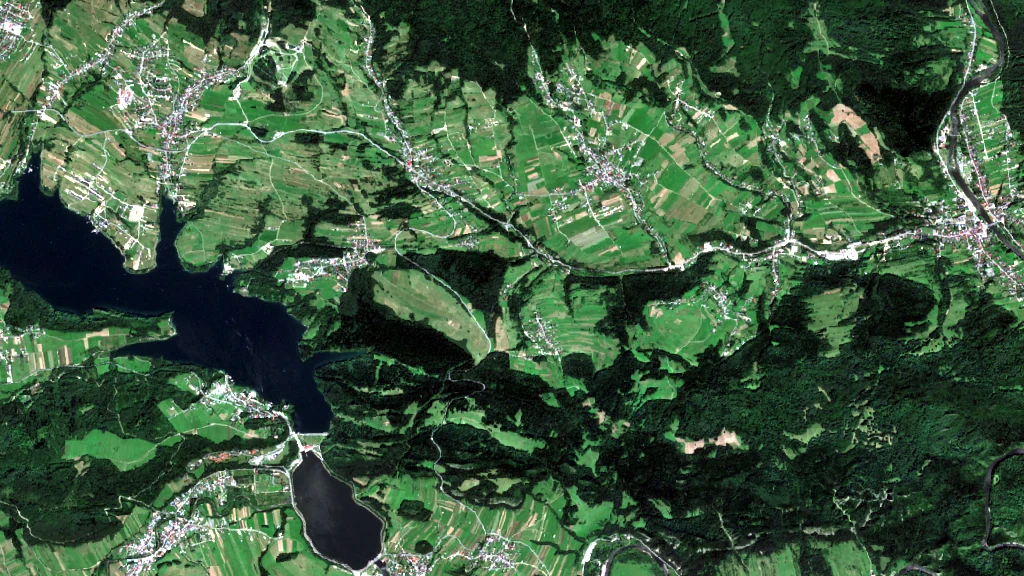
From a blurred lake to a district figure
A clear pass over open water is a fortunate thing, not a guaranteed one. Cloud hides the surface. Optical layers need daylight and a gap in the weather. A single coarse reading can smear several small reservoirs into one grey patch. Read raw, the view will tell you a region's waters are greening or its lakes are shrinking — it won't tell a utility manager whether his intake is about to taste of mud, or a regulator which of fifty reservoirs sits closest to a toxin limit.
Closing that gap is the slower half of the work. It means bringing a soft, intermittent picture down to a named water body and a number someone can defend: the surface area on this pass, the bloom intensity in this arm of the lake, the clarity after this storm, the storage lost since the dam was built. Done carefully, and only as far as the evidence actually reaches, that turns a regional impression into a district-level figure a decision can rest on — gaps marked, not smoothed over.
Why the readings can be trusted
A reading is only as good as the checking behind it. Each reservoir's figures are set against independent references on the ground — routine samples drawn at the intake, the records a dam operator already keeps, gauges on the rivers feeding in. Where the orbital colour says a bloom is building, a grab sample should agree. Where it says clarity has collapsed, the turbidity meters should follow. Every value carries a stated margin of error, and the cadence is honest about itself: a reservoir under a week of cloud gets reported as unseen, not quietly guessed at.
The discipline behind that is unglamorous but it's what holds the whole thing up — publish the uncertainty, and say so plainly when a clear pass simply didn't come. It's also why the orbital view earns its place. No older single method covers the whole water body on a repeating schedule.
| METHOD | WHAT IT SEES | WHOLE WATER BODY? | REPEATING VIEW? |
|---|---|---|---|
| A staff gauge on the dam | the water height at one spot | no, one point | only when read by hand |
| A grab sample at the intake | quality at one tap, one day | no | a spot check, not a trend |
| A bathymetric survey | the floor, in fine detail | yes, once | rare and costly |
| The view from orbit, brought to a named reservoir | extent, colour, clarity, lost room | yes, the whole surface | each clear pass |
Not one reservoir's problem — the world's
The twin losses this briefing tracks — water and room — aren't local quirks. They're measured, global, and documented independently of any single reading here. On storage, the United Nations University estimates the world's large dams have already lost roughly 13–19% of their original capacity to trapped sediment, on course for 23–28% by 2050 — about a third of a percent a year on average, and quite a bit more in aging basins. Japan's dams, most of them past a century old, have already lost around 39%. On quality, the picture is just as consistent. As lakes and reservoirs warm, harmful algal blooms are growing in frequency, duration and reach, and temperature alone explains close to half the variance in bloom extent across studied waters. Different instruments, different institutions, the same two conclusions this briefing reads from orbit, reservoir by reservoir. A 2023 study in Geophysical Research Letters put a number on how well a satellite-only method can track that loss directly: pairing high-resolution Sentinel-2 imagery with daily water-level records across eight US reservoirs, it estimated near-present storage capacity to a mean error of 4.08% and sedimentation rate to 0.05 percentage points a year — accurate enough to revise a reservoir's rating curve between the rare, costly bathymetric surveys that would otherwise be the only ground truth.
Where the losses land — the wire, the river, the tap
A reservoir is rarely just a reservoir. It's the firm capacity a power market counts on, the release that keeps a river navigable through the dry months, the counted reserve behind a city's taps. Each of those rests not on the level at the dam but on the storage behind it — precisely the figure the silt has been revising downward.
For hydropower the loss cuts twice. Less live storage means less water to run through the turbines in a dry year, and less freedom to hold it back and release it when the power is worth the most. A dam's value lies as much in timing as in volume, and timing is the first thing a shrunken reservoir gives up.
For navigation and for cities the logic is the same, one step removed. Barge drafts below a dam rest on releases the reservoir can no longer guarantee. A city supplied from a single lake is holding a reserve counted on paper against a floor no survey has visited in years. And a bloom shortens the odds further, because quality can pull a source out of service faster than any drought can lower it.
What it changes
Read this way, a reservoir stops being a single comforting number and becomes a set of moving facts, each one attached to a decision. A water utility that sees a bloom in the colour days before it reaches the intake has time to switch a source or treat the water instead of issuing an advisory after the fact. A hydropower operator tracking the slow loss of storage to silt can plan the dredging or the drawdown rather than meet it as a surprise in a dry year. A regulator can rank reservoirs by the risk of a toxic bloom and send inspectors where they're actually needed.
The same signal carries beyond the operators, too. The safety margin in a city's drinking water. The firm capacity a power market assumes a dam can hold. The loss an insurer should expect from a warming, greening, silting basin. Each of those is a bet on water that's been hard to see clearly until now. None of this refills a reservoir or cools it down — what it moves is the moment of knowing, forward from the week the water fouls or the drought finds the missing room, to the years before either one turns into an emergency.
A trend a balance sheet can read
The figures that matter here move slowly, and slow figures suit an orbital record well. An operator's stated capacity rests on a bathymetric survey, and surveys are rare and costly — between one and the next, the official number just ages. The orbital read doesn't wait around for that. Surface-water extent gets traced on each clear pass, and the inferred loss of room is revised against the basin's sediment load as the record grows, so the trend exists as a living series instead of a figure frozen the year of the last survey.
That series is also independent of the party it describes. A reservoir's own numbers get compiled by the people who operate it. A reading taken from orbit and checked against ground references answers to neither the operator nor the buyer. For anyone pricing the asset — a lender against a dam, an insurer against the supply behind a city, an investor in the industry downstream — that independence is basically the whole point.
So the decision itself gets plainer. Price the asset against the storage it will actually hold over the life of the exposure, not the storage on the design papers. Set the premium against the measured slope of the loss, with its stated margin of error carried alongside. Where the trend flattens, the risk eases. Where it steepens, the price should say so before the dry year does.
FOR CITATION
A full reservoir can still be failing. Brim-full water can be turning unsafe, and the floor beneath it can be silting up, with no level gauge the wiser.
The water reports its own state. From orbit the surface gives up its extent, its colour and its clarity, read again on each clear pass rather than once by hand.
It lands on a named lake, not a region. The signal is brought down to a single reservoir, given an honest margin of error and a record of the passes it missed.
This is the public briefing.
The subscriber report carries the per-reservoir values in full — extent, bloom intensity, clarity and the storage lost since the dam was built, each with its stated margin of error and a record of the passes the cloud took away.