Your reservoir is losing capacity to silt: measured from orbit, between bathymetric surveys.
A bathymetric survey tells you the storage you had on the day the boat went out, nothing about the years either side of it. Sediment keeps arriving between surveys, water quality keeps shifting, and mostly you are flying blind through all of it. HydroSed reads surface turbidity, plume dynamics and water-extent change from orbit on a repeating cycle, turning them into a sedimentation and water-quality signal for the gap in between: each value carrying its own quantified uncertainty.
A continuously updated reservoir sediment-and-quality layer fills the gap between costly surveys. Every estimate is bounded by a calibrated interval and benchmarked against in-situ measurements, built to stand up in a dam-safety file rather than sit on a slide.
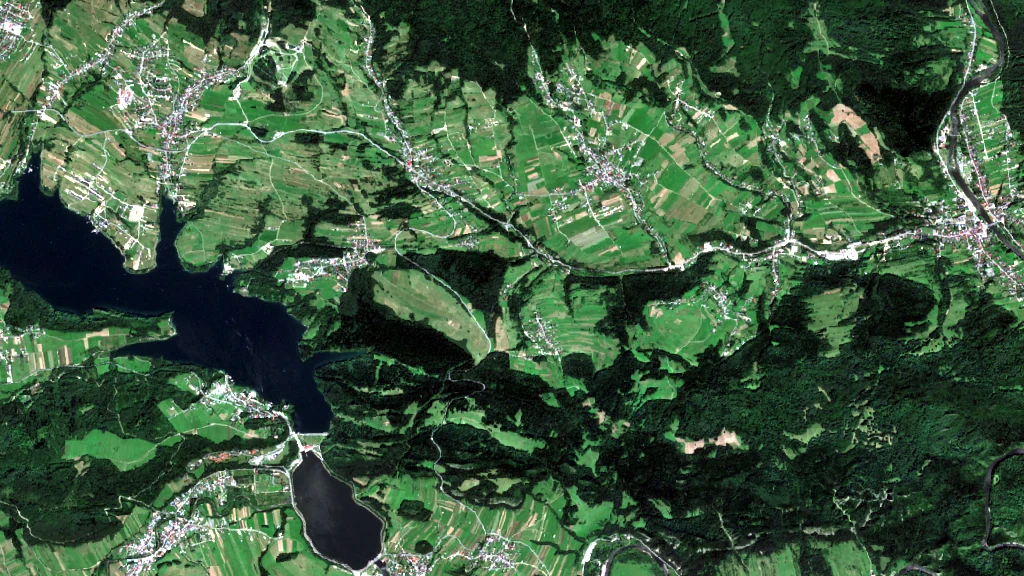
Built for the questions a dam owner actually asks.
No measured accuracy percentage is quoted below, on purpose. What sets this apart is that every estimate ships with a calibrated, validated uncertainty band, and the method's blind spots are stated rather than hidden.
How do I trust a number from space in a dam-safety file?
You trust it because it arrives with its limits attached. Each estimate is delivered as a conformal prediction interval with guaranteed coverage, a turbid plume, a partial cloud or a low sun angle widens the band instead of producing a confident wrong answer. The surface signal is benchmarked against in-situ measurements, too. Where you hold sediment cores, turbidity probes or a recent bathymetric survey, those become the reference the satellite layer is checked against.
- Anchored to your survey. A bathymetric survey is the ground truth that calibrates the inter-survey signal: we extend it, we do not overrule it.
- Honest flagging. Scenes too clouded or turbid to resolve are flagged, not silently filled.
- Validation pack. The comparison protocol and residuals ship with the product and stay current.
How fine, how often?
Spatial: per-pixel surface mapping across the reservoir footprint, resolving plumes, near-shore deposition zones and the inflow delta separately from open water.
Temporal: refreshed on the satellite revisit cycle: optical passes depend on clear sky, while radar water-extent continues through cloud.
Does it reach my control room?
- API: time series and per-zone values for programmatic pull.
- GeoTIFF: georeferenced layers for GIS and asset records.
- PDF report: survey-style brief for the dam-safety file.
The API exposes standard tag-style values and intervals that a SCADA / historian integration can ingest as derived points alongside existing instrumentation.
Optical light cannot see through deep or very turbid water
This is the central honest limit. Optical sensing reads the surface and near-surface; it cannot directly measure deposition on the bed of a deep reservoir, and very turbid water saturates the signal outright. A satellite does not replace a survey boat, and we do not pretend otherwise. So we mitigate it three ways. First, we infer bed accumulation from the surface sediment budget, what the catchment delivers and what settles, calibrated against your bathymetry. Second, we fuse radar-derived water extent and level so storage change is still tracked when optical is unusable. Third, every inferred value carries a wider interval the further it sits from direct observation, which keeps the uncertainty visible instead of buried.
Cloud cover interrupts optical passes. We state the gaps explicitly and lean on radar to keep extent continuity through them.
Where it fits dam-safety practice
Outputs are designed to support periodic bathymetric survey obligations and dam-safety monitoring regimes, not replace them, and they give you an auditable inter-survey record. Processing runs under EU data residency.
We do not hold a dam-safety certification or regulatory seal, and we are not going to claim one. What the product does is feed the file your engineers and regulators already maintain.
What you actually receive
- API time series with value + interval per zone
- GeoTIFF raster layers (sediment / turbidity / extent)
- Vector tables (CSV / GeoPackage)
- PDF survey-style reports
- SCADA / historian-ingestible feed
The window it covers
HydroSed is primarily a monitoring and trend product. It closes the multi-year gap between surveys with a near-continuous record and a capacity-loss trajectory. Where inflow and catchment delivery are well observed, it also supports short-range outlook on sediment-load and turbidity events tied to high-flow inputs, always with the uncertainty band attached.
One table for the procurement file.
| ATTRIBUTE | HYDROSED · RESERVOIR SEDIMENTATION & QUALITY |
|---|---|
| Primary client | Dam & reservoir operators, critical-infrastructure owners, water utilities |
| Spatial resolution | Per-pixel surface mapping across the reservoir footprint |
| Update frequency | Satellite revisit cycle; radar maintains continuity through cloud |
| Uncertainty | Calibrated prediction interval (conformal, guaranteed coverage) on every value |
| Validation reference | In-situ sediment / turbidity measurements and client bathymetric surveys |
| Delivery | API · GeoTIFF · vector tables · PDF report · SCADA-ingestible feed |
| Integration | SCADA / historian-ingestible feed; standard GIS import |
| Horizon | Inter-survey monitoring and capacity-loss trend; event-scale outlook where inflow is observed |
| Key limitation | Optical cannot see deep/turbid water directly: mitigated by surface-budget inference + radar fusion + wider intervals |
| Compliance relevance | Supports bathymetric-survey and dam-safety monitoring regimes; EU data residency |
What this product does not do.
- It does not replace a bathymetric survey. It extends one between campaigns; survey data remains the calibrating ground truth.
- It does not see the reservoir bed directly. Bed accumulation is inferred from the surface budget and carries a wider interval the further it is from direct measurement.
- Cloud and extreme turbidity interrupt optical sensing. Gaps are stated; radar maintains water-extent continuity through them.
- No trained-model accuracy headline is claimed here. The guarantee is calibrated interval coverage, validated in situ.
Evidence, when the pilot closes.
Reservoir sedimentation pilot
This slot is reserved for a completed operator pilot, and we are not going to publish a case study before the work actually exists. When a pilot does close, it will carry the reservoir context, the comparison against that operator's own bathymetric and in-situ data, and the realised interval coverage.
Request the validation pack.
The full comparison protocol, residual tables against in-situ reference, and the inter-survey monitoring spec ship under NDA with every pilot.
Start a pilot See how we validate