Panama: when a single lake sets the price of global trade.
Roughly 5% of world maritime trade moves through one 82-kilometre cut across the isthmus. The Panama Canal isn't a sea-level ditch, though — it's a staircase of locks lifted 26 metres above the oceans, and every step runs on rainwater held in Gatun Lake. When El Nino and a record dry spell pulled that lake toward historic lows in 2023, the Canal Authority rationed daily slots, draft limits fell, and a queue of ships piled up off both coasts. The market did the rest: a single priority slot was auctioned for a reported US$4 million. That's really the thesis of this piece. Earth observation here isn't a science demo — it's decision-grade business intelligence for shippers, insurers and infrastructure managers, and the analytical toolkit to read it already exists in orbit.
BRIEFINGAS OF 2026-06-30WEEKLY CADENCEANALYSIS DESK: ORBISPECTv1.0
KEY JUDGMENTS
The canal's capacity is gated by hydrology, not headlines. Every lockage drinks roughly 200 million litres of fresh water from Gatun Lake, so the daily slot count tracks the reservoir — when the 2023 drought pulled the lake toward ~80 ft against a more typical ~88 ft, slots were rationed from about 36–38 to as few as 24 a day.
Lake level leads the freight rate by weeks, but does not guarantee it. Reservoir extent and catchment water balance point to where capacity is heading before any official advisory says so. In 2023 the draft cut from 15.24 m to 13.41 m followed the falling lake. The signal is indicative, not a promise.
The drought repriced passage in real money. As slots tightened, a single priority transit auctioned for a reported US$4M (~US$3.98M, 8 Nov 2023) against a ~US$2.6M prior record — a market reaction read directly from reported figures, not modelled.
Outlook — a warm ENSO phase raises repeat-drought risk, with about a month of lead time. ENSO drives Panama's rainfall, so a warm phase tilts the odds toward another squeeze; real-time reservoir monitoring gives roughly 30 days to confirm or rule it out. This is a scenario input, not a prediction.
Two independent layers converge here: vessel-movement analytics over the canal approaches, and satellite-derived environmental layers — Gatun Lake surface extent and catchment water balance. The judgments sit where the queue and the reservoir agree; neither layer alone would carry them.
SHARE OF GLOBAL MARITIME TRADE
~5%by volume, via the canal
DAILY SLOTS · DROUGHT FLOOR 2023
24/daycut from ~36-38 normal
NEOPANAMAX DRAFT · RESTRICTED
13.41 mdown from 15.24 m
RECORD SLOT AUCTION · 8 NOV 2023
US$4Mone priority transit
WATER PER LOCKAGE
~200 MLfresh water, per transit
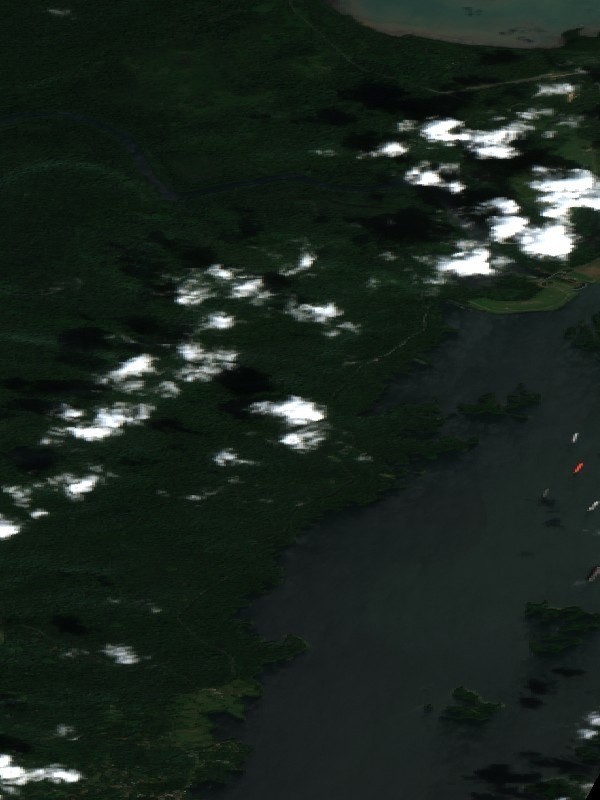
THE QUEUE, FROM ORBIT — EVERY BRIGHT SPECK IS A SHIP WAITING TO TRANSITOPTICAL SATELLITE IMAGERY · 18 AUG 2023 · DROUGHT PEAK
REAL IMAGERY · reference OPTICAL ARCHIVE · ACQUIRED 18 AUG 2023, PACIFIC APPROACH ~8.9N 79.5W · CLOUD-FREE WINDOW DURING THE GATUN LAKE DROUGHT
The 2023 drought cut daily transits to a floor — then the refilled lake brought them back
VESSEL-MOVEMENT ANALYTICS · WEEKLY AVERAGES · THE 2023 TROUGH IS THE DROUGHT RATIONING; 2024-25 RECOVERY FOLLOWS THE REFILLED LAKE.
THE NOV 2023 TROUGH IS WHERE THE CANAL AUTHORITY RATIONED SLOTS TO AS FEW AS 24/DAY, AGAINST A NORMAL ~36-38.
Watching the water before it becomes a freight rate
The canal does not run on geopolitics. It runs on a reservoir. The first question any operator asks — how much water is in Gatun Lake, and which way is it moving — is answerable from orbit with satellite optical imagery at ~10 m.
Optical baseline. Satellite optical imagery photographs Gatun Lake and the upstream Alajuela (Madden) reservoir whenever the sky is clear — down to roughly 10 m ground sampling on the visible and near-infrared bands, refreshed every few days. As the lake falls, the shoreline retreats. Mudflats and exposed lakebed show up where there was water just weeks before, and that receding edge is basically a direct, visual measurement of stored volume.
Water-extent mapping, or turning pixels into surface area. A water-extent index contrasts the green and near-infrared bands so water goes strongly positive and land goes negative — the formula McFeeters published in 1996 as the Normalized Difference Water Index. A later refinement, Xu's 2006 Modified NDWI, swaps in a shortwave-infrared band instead, which suppresses false positives from built-up land and better separates a muddy, receding shoreline from the water itself. Threshold it per pixel and you get a clean water mask. Count the masked pixels, multiply by pixel area, and out comes lake surface area in square kilometres, tracked image by image. Pair that time series with the reservoir's known depth-area-volume curve and the flat 2-D surface turns into a volume estimate.
Drought context. A dry month and a structural decline can look similar from a single reading. Standardised drought indices — precipitation anomalies and vegetation-condition indices over the watershed — place that single low reading in its multi-year context, so the two aren't confused. In 2023, Gatun sat near 80 feet through the back half of the year, against a more typical ~88 feet at the close of the wet season.
B2B BENEFITWith a 10 m water mask refreshed every few days, an infrastructure manager or commodity desk watches stored volume trend down in near real time — the squeeze becomes visible while there is still time to hedge tonnage, not after the slot cuts are announced.
GATUN LAKE · FULL POOLSENTINEL-2 · 18 DEC 2022
GATUN LAKE · 2023 DROUGHTSENTINEL-2 · 10 MAR 2023
REAL IMAGERY · SENTINEL-2 L2A, COPERNICUS DATA SPACE ECOSYSTEM · SAME NORTHERN ARM OF GATÚN LAKE, ~9.2N 79.9W · THE CHANNEL VISIBLE IN THE MARCH 2023 SCENE IS FULLY SUBMERGED IN THE DECEMBER 2022 SCENE
Panama is cloudy — so count the ships with radar
The image above is a rare cloud-free day. Most days, the tropical isthmus is under cloud, and optical sensors see white. Synthetic Aperture Radar does not care.
Why radar works here. All-weather radar — synthetic-aperture radar — emits its own microwave pulses and measures the echo, so it images day or night, straight through cloud and rain. A steel hull happens to be a strong corner reflector. Microwaves bounce off the metal and the deck structure and come back as a bright point against the radar-dark sea, so ships light up as discrete targets even when the optical scene is nothing but overcast.
Counting the queue. Detect and count those bright targets in the anchorage off Balboa (Pacific) and Cristobal/Colon (Atlantic) and you get a vessel count at anchor. The image at the top of this page is the optical version of exactly that signal — dozens of ships parked offshore in August 2023. Track how the count rises and falls week to week and you have an instant, independent supply-chain throughput indicator. A growing anchorage means congestion is building, and it shows up before any official advisory confirms it.
B2B BENEFITWith all-weather radar counting the anchorage, an insurer can price delay risk in near real time and a freight desk can flag a building backlog days ahead of the rate move — rather than learning about it from the spot market.
The forest is part of the canal's plumbing
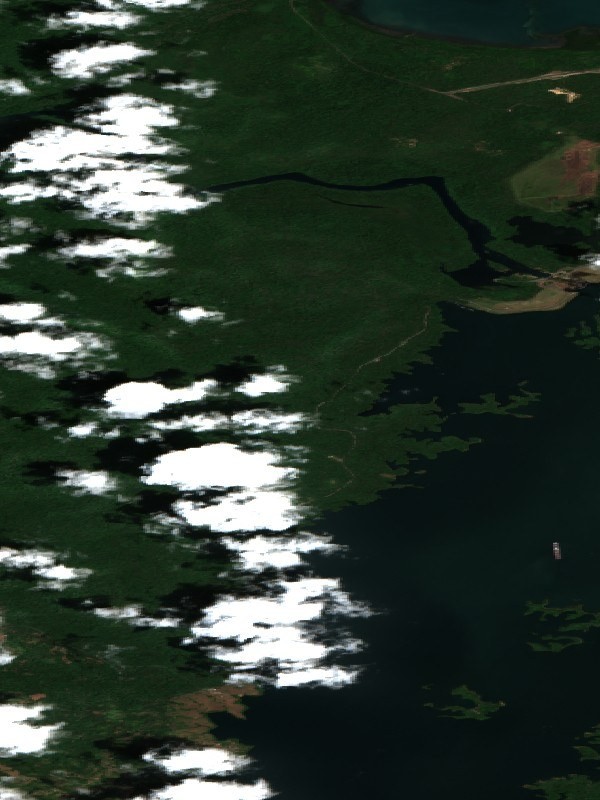
Gatun Lake is only as reliable as the tropical forest around it. The watershed — the upper Rio Chagres basin alone supplies close to half the water the canal needs — works as a retention sponge.
Why the trees matter. Porous, forested soil absorbs heavy tropical rain and releases it slowly through the dry season, smoothing the flow into the reservoir. Strip the forest, though, and bare soil sheds rain in fast, muddy pulses. The water floods through and runs to sea instead of being banked. And the runoff carries sediment that silts up the lake, eroding the very storage capacity the canal depends on.
What EO monitors. Optical time series flag deforestation and land-clearing as they happen. A vegetation index — the near-infrared-minus-red contrast that scales with healthy green biomass — tracks canopy vigour and stress across the watershed. So falling vegetation vigour over a slope becomes an early flag, first for erosion potential, then further downstream for reservoir sedimentation.
B2B BENEFITFor the entity managing the watershed, vegetation-vigour and change-detection layers turn forest cover into a measurable risk variable — letting reforestation spend and erosion-control effort be targeted at the slopes that actually feed the lake.
THE PLUMBING, FROM ORBIT — GATUN LAKE’S BRANCHING ARMS AND THE FOREST THAT FEEDS THEMOPTICAL SATELLITE IMAGERY · CANAL WATERSHED
REAL IMAGERY · reference OPTICAL ARCHIVE · CANAL WATERSHED, GATUN LAKE AND UPPER CHAGRES BASIN
Water-extent mapping sees the shape. Altimetry sees the depth.
A water mask is two-dimensional — it tells you how wide the lake is, not how deep. Ship draft depends on the exact lake level, and that is what altimetry measures.
Measuring water height from orbit. Radar and laser altimeters fire a pulse straight down and time the return to fix the water-surface height. Reference-grade radar altimetry, and newer wide-swath interferometric altimetry that maps a water body in two dimensions rather than along a single ground track, can resolve inland water-surface elevation to the centimetre class. That is an actual lake level, not a surface outline.
The limit worth knowing. Centimetre accuracy is real, but it only holds for water bodies large enough to fill the sensor's footprint cleanly. Published validation work puts uncertainty at roughly 8–10 cm for large lakes, widening toward the decimetre range for small or narrow ones, and reference-mission repeat cycles typically run 10–27 days. The NASA/CNES SWOT mission, launched in December 2022, pushes this further with a Ka-band radar interferometer imaging swaths up to 120 km wide rather than a single ground track — published validation puts its water-surface-elevation error at roughly 10 cm for non-vegetated water bodies larger than 1 km², degrading sharply below about 0.5 km². Gatun Lake, at roughly 425 km², sits comfortably inside that reliable range. But a single altimetry pass won't catch a sudden lock-release or a flash-flood pulse between overpasses, which is exactly why the level series here gets fused with the optical shoreline record and the watershed water balance rather than read from altimetry alone.
Why centimetres are money. The Panama Canal Authority sets a maximum permissible draft against the available depth over the lock sills. In the 2023 drought the Neopanamax draft limit was cut from the normal 15.24 m (50 ft) toward 13.41 m (44 ft) — nearly two metres of cargo a vessel could no longer carry through. A bulk or container operator can convert that lake level directly into a loadable draft, and from there into a cargo mass or TEU ceiling, weeks before the ship even reaches the lock.
B2B BENEFITCentimetre-class altimetry lets a shipper translate next month's likely lake level into how many tonnes — or how many TEU — can actually transit, and load the vessel accordingly at origin instead of stranding cargo at the lock.
WHY LEVEL IS EVERYTHING — THE CANAL CLIMBS OVER A RAISED ISTHMUS, FED BY A LAKE ABOVE THE SEASATELLITE ELEVATION MODEL · ISTHMUS RELIEF
REAL IMAGERY · reference ELEVATION ARCHIVE · SHADED-RELIEF PERSPECTIVE OF THE ISTHMUS AND CANAL
Market reaction · what one transit slot cost at auction
RECORD WINNING AUCTION BID (US$M)
REAL REPORTED FIGURES, NOT MODELLED · AS THE DROUGHT CUT DAILY SLOTS, SHIPPERS BID FOR PRIORITY PASSAGE. THE PRIOR RECORD WAS ~US$2.6M (NOV 2022); ON 8 NOV 2023 A WINNING BID REACHED THE US$4M MARK (REPORTED OFFICIALLY AS ~US$3.98M, JAPAN'S ENEOS GROUP, AN LPG CARRIER) — ON TOP OF STANDARD TOLLS, BRINGING ITS TOTAL TRANSIT COST TOWARD ~US$4.5M. SOURCE: MARITIME TRADE PRESS — AS REPORTED.
A canal that drinks rain
Every passage through the locks consumes roughly 200 million litres of fresh water from Gatun Lake. When the 2023 drought arrived, the Canal Authority cut slots from about 36-38 to as few as 24 a day by November, visible in the transit chart as a sharp dip. The rains of 2024-25 rebuilt the level, and traffic recovered along with it.
Why this is an EO story: it's the one major trade gate whose capacity is set by hydrology, not headlines. Lake level, catchment water balance and shoreline extent are exactly what the orbital toolkit measures.
A leading indicator, not a guarantee: lake level tends to lead the slot count by weeks. So it points to the likely direction of capacity rather than confirming it. Indicative, not a promise.
Who rides on it
US Gulf grain → Asia: the main alternatives are the Cape of Good Hope (adds roughly two weeks) or rail to the Pacific. Water restrictions in Panama lift rates on grain routes almost immediately.
LNG, LPG and containers: at the peak of the 2023 drought, priority-slot auctions reached millions of dollars per passage.
Scenario, moderate confidence: El Nino / La Nina (ENSO) drives Panama's rainfall, so a warm ENSO phase raises the risk of a repeat. Published hydroclimate studies of the watershed put the effect at roughly 8% less rainfall during El Nino episodes versus an ENSO-neutral year — a modest-sounding number that, compounded over a wet season, is enough to swing the lake between a full pool and a rationed one. Real-time reservoir monitoring gives roughly a month of lead time to confirm or rule it out. A scenario input, not a prediction.
Not just how many ships — which ships
A bright dot on radar is a start. Modern SAR analytics push further: classifying the vessel, catching the ones hiding, and watching the locks themselves move.
Ship-type identification. A vessel's radar signature — how strongly it reflects radar — scales with its size and superstructure, and its polarimetric response differs by hull form. All-weather radar can transmit and receive in dual polarisation, and the ratio and texture of those channels, fed to a machine-learning classifier, is often enough to separate a bulk carrier from a container ship from a tanker through complete cloud cover. No optical view required.
Dark vessels via radar and AIS fusion. Most ships broadcast their identity and position over AIS. Fuse the radar detections with the AIS feed, and what gets interesting are the mismatches. A hard radar target with no matching AIS signal is what the industry calls a dark vessel — a ship that has switched off or is spoofing its transponder. Radar sees the physical object regardless of what the transponder claims.
Radar interferometry for the structures. Comparing the phase of repeat radar passes measures ground and structure displacement at millimetre-to-centimetre scale. Over the lock chambers, approach walls and surrounding terrain, radar deformation analysis can flag subsidence and slow movement — an early, remote check on the stability of the fixed infrastructure itself.
B2B BENEFITClassifying the queue by ship type tells a desk whether the backlog is gas, grain or boxes — i.e. which market is exposed — while radar+AIS fusion and radar deformation analysis give insurers and asset owners an independent view of compliance risk and structural integrity.
Rain on the gauge is not water in the lake
Knowing it rained is not enough. The decision-grade question is how much of that rain actually reaches the reservoir — and that depends on the state of the soil and the broader water mass of the region.
Soil moisture. Microwave soil-moisture radiometry measures the moisture in the top layer of soil across the watershed. Dry, parched soil absorbs the first rains rather than passing them downstream. Soil already near saturation just lets the rain run off into the lake. So soil-moisture state ends up being a leading variable for how effective the coming wet season will actually be at refilling Gatun.
Gravimetry for the macro deficit. Satellite gravimetry detects tiny changes in Earth's gravity field caused by shifts in total water mass — surface water, soil moisture and groundwater combined. The NASA/DLR GRACE and GRACE-FO missions, which measure this by timing the changing distance between a twin pair of satellites, resolve it natively at a coarse ~300 km scale — basins on the order of 60,000–250,000 km² are what the raw signal can carry with useful accuracy, so a single small watershed like Panama's isn't resolved directly. At regional scale, though, this reveals a cumulative water deficit or surplus that a single lake gauge simply can't, putting one reservoir's level inside the basin-wide water budget.
B2B BENEFITSoil-moisture and gravimetry layers let a risk team judge whether a forecast wet season will genuinely relieve the canal or merely soak into dry ground — sharpening the lead time on a capacity call from days to weeks.
The million-dollar decision: wait, bid, or go around
When the canal tightens, a shipper faces a hard, expensive choice — and Earth observation is the predictive feed that informs it.
The choice. A vessel can join the queue and wait. It can bid for a priority slot at auction, which during the 2023 drought hit a reported US$4 million for a single passage (officially ~US$3.98M, paid by Japan's Eneos Group for an LPG carrier on 8 November 2023, on top of standard tolls). Or it can reroute entirely, around Cape Horn or the Cape of Good Hope, trading days at sea and extra fuel and CO2 for certainty of passage. For a major line such as Maersk or MSC, the difference runs to millions of dollars per ship and weeks of schedule.
EO as the predictive engine. Lake level, soil moisture, anchorage counts and transit cadence are the live inputs to a supply-chain digital twin — a running simulation of the network. Feed the orbital signals in, and the twin can model, roughly 30 days ahead, the fuel cost, CO2 and time-loss of waiting versus rerouting for a given vessel and cargo. That's what turns a gut call into a costed decision.
B2B BENEFITWith reservoir and queue signals feeding a digital twin, a line can decide weeks early whether to pay the slot premium or send a ship the long way — and an insurer can price that exposure before the bidding war starts.
Resolution, cadence and what each one answers
The capability stack, by the question it answers
OPTICAL SATELLITE IMAGERY
Visible/near-infrared imagery down to ~10 m ground sampling, refreshed every few days, used for water-extent and vegetation indices. The foundation for tracking lake area and watershed health.
ALL-WEATHER RADAR
Synthetic-aperture radar that images day or night, straight through cloud and rain; dual-polarisation channels drive ship detection, ship-type classification by radar signature, and structural deformation analysis.
WATER-LEVEL ALTIMETRY
Reference-grade radar altimetry and wide-swath interferometric altimetry that resolve inland water-surface elevation to the centimetre class — an actual lake level, not just a surface outline.
SOIL-MOISTURE RADIOMETRY
Microwave radiometry of the top soil layer across the watershed — a leading variable for whether the coming wet season actually refills the reservoir.
SATELLITE GRAVIMETRY
Detects regional shifts in total water mass — surface water, soil moisture and groundwater combined — revealing a basin-wide deficit a single lake gauge cannot.
VERY-HIGH-RESOLUTION IMAGERY
Commercial optical imagery at sub-metre, 30 cm-class ground sampling, taskable on demand, used for individual-vessel and lock-scale detail.
HIGH-CADENCE REVISIT
Dense small-satellite fleets push effective revisit toward hours rather than days over a priority area, for rapid re-looks when a situation is moving.
A 10 m water mask every few days, a 30 cm look on demand, an hourly-class revisit from a dense fleet — these are different tools answering different questions: structural volume trend, individual-vessel identification, rapid re-look. Choosing the right resolution and cadence, honestly, is most of the analytical work.
An early-warning hub for the isthmus, not a data warehouse
Panama also hosts a regional Earth-observation centre serving governments across Latin America and the Caribbean.
What it is. The centre is a regional hub that brings Earth-observation data and services to governments across a region highly exposed to climate-driven hazards. Its mandate is climate resilience, so the point is turning satellite signals into decisions rather than piling them up as archives.
Why it matters for the canal story. It is built as an operational early-warning capability. Among its thematic services are dedicated drought and wildfire monitoring alongside flood mapping, drawing on the same satellite signals described above and feeding regional disaster-risk-reduction decisions. The hydrology that governs the canal sits inside exactly the drought-and-forest signals such a hub is designed to watch.
B2B BENEFITA regional hub turning satellite feeds into operational drought and fire early-warning means the underlying data layer behind canal-risk intelligence is regional and continuously maintained — not a one-off study.
Method, honesty & what this does not claim
The toolkit vs. the product. This guide describes the full Earth-observation toolkit the field offers over a chokepoint like Panama: optical hydrology and water-extent mapping, all-weather radar ship detection and classification, water-level altimetry, radar deformation analysis, soil-moisture radiometry and gravimetry, data fusion. These are the analytical capabilities Orbispect's expertise covers. We do not claim to operate every one of them as a live, productised service — several (centimetre altimetry, radar dark-vessel fusion, radar deformation, gravimetry, soil-moisture radiometry) are presented as what the discipline enables, not as something we're already running day to day.
What we actually run on this story: vessel-movement analytics through the canal, paired with satellite-derived environmental layers — Gatun Lake surface extent and catchment water balance. Transit counts refresh weekly. Reservoir levels are tracked through the dry and wet seasons.
Figures are real and cited. Every number here — the ~5% trade share, the 24/day drought floor, the 15.24 m → 13.41 m draft cut, the ~200 ML per lockage, the US$4M (~US$3.98M) record slot — comes from the sources listed below, reported as such. We haven't modelled any of it ourselves.
WHAT THIS DOES NOT PROVE: cargo manifests, ownership, tonnage on a specific hull, or intent. Lake level is a leading indicator of capacity, not a guarantee of it.
SOURCES & FIGURES
Trade share ~3-5% of global maritime trade — international trade statistics; Panama Canal statistics. |
Draft cut 15.24 m (50 ft) normal → 13.41 m (44 ft) restricted, daily slots ~36-38 → 24 by Nov 2023, ~80 ft vs ~88 ft lake level — maritime advisories and transport statistics. |
Record slot auction US$4M / ~US$3.98M, Eneos Group LPG carrier, 8 Nov 2023, total cost ~US$4.5M — maritime trade press (as reported). |
~200 ML fresh water per lockage; watershed as retention sponge, upper Rio Chagres ~half of canal water, deforestation → erosion/sedimentation — watershed studies and hydrology research. |
NDWI (McFeeters, 1996) and MNDWI (Xu, 2006) water-index formulations — peer-reviewed remote-sensing literature. |
SWOT mission water-surface-elevation accuracy (~10 cm for non-vegetated water bodies >1 km²) — NASA/CNES SWOT validation studies. |
ENSO rainfall effect on the Panama Canal Watershed (~8% reduction in El Nino years vs. ENSO-neutral) — published watershed hydroclimate research. |
GRACE/GRACE-FO terrestrial water storage native resolution (~300 km, basins ~60,000–250,000 km²) — NASA/DLR GRACE mission literature. |
reference imagery — optical and elevation archives (ship-queue scene 18 Aug 2023; canal watershed; isthmus shaded-relief elevation model).
FULL REPORT
This is the public field guide.
The subscriber report carries the weekly transit series, Gatun Lake surface extent and catchment water-balance trend, and the lead-time read on capacity in full — refreshed every week, with the underlying figures and their stated uncertainty.